Custom packaging does not always need bold colours or large printed graphics to make a brand recognizable. For restaurants, cafés, retailers and foodservice brands, embossed packaging offers a more subtle way to add a logo, pattern or message directly to the package. Instead of applying ink to the branded area, the design is formed in the packaging itself, adding texture while keeping the overall presentation clean.
Amhil offers embossed packaging across selected hinged containers, portion and clear cups and lids, giving brands another way to customize food packaging without relying only on print.
What Is Embossed Food Packaging?
Embossing creates a raised or recessed design directly in the packaging material. That design usually includes:
- A logo
- A brand mark
- A pattern
- A short message
- A simple icon
Amhil can emboss logos, patterns and messages on hinged containers, portion cups and lids. The process adds texture and branding without using ink on the embossed area. This makes embossing different from custom printing, where colour, text or artwork is applied to the surface. Neither approach is automatically better. The right choice depends on what the brand needs the package to communicate.
When Does Embossing Make More Sense Than Printing?
Embossing works particularly well when the brand wants the package itself to carry the identity without adding a large printed design.
|
Branding Goal |
Embossing May Be a Better Fit |
Printing May Be a Better Fit |
| Add a subtle logo or brand mark | Yes | Possible, but may be more visible than needed |
| Keep clear food packaging visually open | Yes | Depends on print coverage |
| Add texture to the package | Yes | No |
| Use several brand colours | Limited | Yes |
| Reproduce detailed artwork | Limited by package and design | Better suited to complex graphics |
| Add a simple pattern or message | Yes | Yes |
| Avoid ink on the branded area | Yes | No |
| Run a colour-focused campaign | Less suitable | Better suited |
The decision should start with the design objective rather than the decoration method. If colour is central to the brand, printing may make more sense. If the goal is a clean, understated logo or pattern, embossing may be the stronger option.
Use Embossing When Product Visibility Matters
Clear packaging often works best when customers can see the food. For fresh-cut fruit, bakery items, confectionery, deli foods and other visible products, a large printed area may cover part of what the customer wants to see.
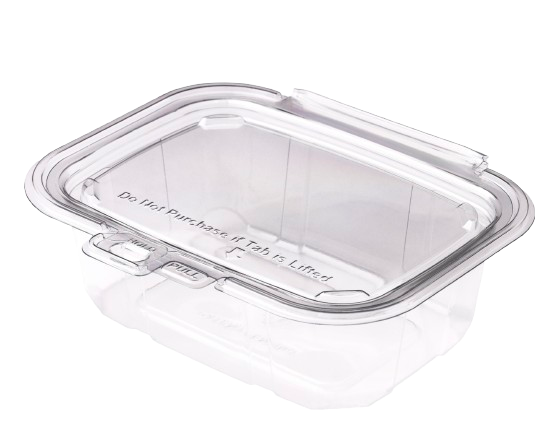
Amhil’s hinged containers are made from clear PET and are designed for products including fresh cut fruit, nuts, confectionery, deli and bakery packaging. Custom embossing is available on these containers. An embossed logo can add branding while allowing most of the package to remain clear.
This can be useful when:
- The food itself is visually important
- The package is displayed on a shelf
- The brand wants a minimal appearance
- A large label or printed area would cover the product
- The same clear package is used for several foods
The goal is not to eliminate labels or required information. It is to use the available package space more intentionally.
Use Embossed Lids for a Subtle Brand Detail
Lids are another natural place for embossing because they are often one of the first parts of the package a customer sees or touches. Amhil includes lids among the packaging formats that can carry an embossed logo, pattern or message. Embossed lids may work well when:
- The base needs to stay clear
- The product should remain visible
- The brand wants a small, repeated detail
- The package is viewed from above
- The same lid is used across multiple products
A simple logo or icon will usually translate more clearly than a large amount of text. Before choosing the design, the brand should also consider functional areas of the lid so the embossed detail does not interfere with how the package is used.
Choose Embossing When You Want Branding Without Ink
One of the clearest differences between embossing and printing is that Amhil’s embossing process creates the branded detail without ink on that area. For some brands, that alone may make embossing worth considering. This can be relevant when a business wants:
- A more minimal package design
- Branding that does not depend on colour
- A logo or pattern built into the package
- Less printed decoration on a clear container
- A consistent mark across several packaging formats
For brands with circularity goals, the decoration method may also be worth discussing during the packaging selection process. Embossing does not automatically make a package more recyclable. Recyclability still depends on the base material, the full package design and the recycling system where the package is used. However, embossing gives brands a way to add visible customization without adding ink to the embossed area.
When Is Printing the Better Choice?
Embossing is not the right answer for every branding project. Printing may be a better fit when the package needs:
- Multiple brand colours
- Detailed graphics
- Seasonal artwork
- Promotional messaging
- Large amounts of text
- Strong visual contrast
- Designs that change frequently
Amhil offers custom print solutions alongside embossing, so the decision does not need to be one or the other across the entire packaging program. A brand may use printed cups for beverages, embossed hinged containers for fresh foods and embossed lids for selected products. The goal is to choose the customization method that fits each package.
Keep the Embossed Design Simple
Embossing usually works best when the design is easy to recognize. Before sending artwork, consider:
- Logo complexity: A simple logo may translate more clearly than artwork with many small details.
- Text length: Short messages are easier to work with than long blocks of copy.
- Placement: The embossed area should be positioned where customers can see it without interfering with labels, openings or other functional parts of the package.
- Package shape: A design that works on a flat lid may need to be adjusted for a curved or smaller surface.
- Brand consistency: The embossed logo or pattern should match the brand assets already used across printed packaging, signage and other customer touchpoints.
Consider Embossing as Part of the Full Packaging Design
Embossing should not be selected in isolation. The first questions should still be:
- What food or beverage is being packaged?
- Which package fits the product?
- Does the customer need to see the contents?
- What information must appear on the package?
- Where will branding be most visible?
- Is colour important to the design?
- Does the same branding need to work across several formats?
Once the right package is selected, embossing can be evaluated as one part of the overall branding approach. This is especially important for clear packaging. The branding method should support the product presentation rather than compete with it.
How Does Amhil’s Custom Packaging Process Work?
Amhil’s custom packaging process begins with understanding the customer’s brand and packaging goals.
The process includes four stages:
1. Understanding the brand: Customers provide artwork, logos, slogans, brand guidelines and other assets.
2. Design: Amhil’s graphics team works on how the branding can be applied to the selected packaging.
3. Validation: The product and packaging specifications are reviewed with the customer to confirm that the brand and product goals are being met.
4. Production: Once the design and specifications are approved, production is scheduled and the packaging is manufactured at scale.
For an embossed package, this process gives the brand an opportunity to review the design in the context of the actual container, cup or lid before production.
Add Branding Without Overcomplicating the Package
Embossed packaging can give foodservice brands a clear, understated way to add identity to lids, hinged containers and portion cups. For products where visibility, simplicity or a clean presentation matters, embossing can add a logo, pattern or message without using ink on the embossed area.
Amhil offers custom packaging solutions that include embossed food packaging, printed packaging and other branding options for restaurants, cafés, retailers and foodservice operators. Contact Amhil to discuss whether embossing is the right fit for your packaging, product and brand.